Back From the Bench: Testing a Repaired LTC Miner in 22 Days
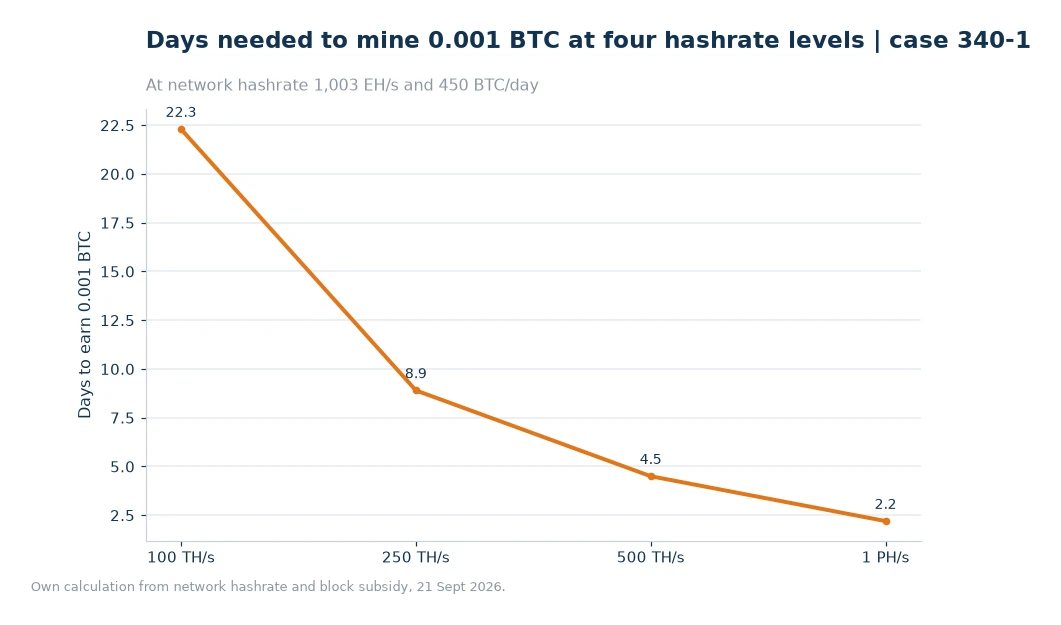
A repaired machine is a hypothesis until shares arrive. On a test bench the useful target is small and quickly resolved: 0.001 BTC of value takes about 22.3 days at 100 TH/s on the yardstick used here, 8.9 days at 250 TH/s and 2.2 days at 1 PH/s. A workshop that waits for a month of customer statements to find out whether the fix held is not testing anything.
Key takeaways
- A 0.001 BTC value target resolves in 22.3 days at 100 TH/s and 8.9 days at 250 TH/s on the chart's yardstick.
- Compare the first 24 hours against 0.00004486 BTC at 100 TH/s; a third of a day's output missing is a real signal.
- Test with the customer's actual pool settings, including the merged-mining worker name, not a bench account.
- Record the result beside the serial number so a second failure has a baseline.
A repair is a hypothesis until shares arrive
Replacing a fan, a PSU or a hash board is a physical act with a measurable outcome, and the measurement is not the fan spinning. It is the share rate at the pool over a period long enough to average out the noise. A bench test that only looks at a local dashboard is checking the machine against itself, which is the one opinion that cannot detect a fault in the machine's own reporting.
So the protocol needs three things: the customer's pool configuration, a target large enough to be meaningful and small enough to finish this week, and a written expected figure. Without the third, the technician has a feeling. With it, the technician has a pass or fail.
There is a fourth thing worth adding, and it is the one most benches skip: a photograph of the job sheet before the machine is closed up. Serial numbers get copied down wrong, and a picture of the label beside the test figure costs nothing and settles arguments months later when nobody remembers which unit was in which slot.
The result is a workshop that can tell a genuine hardware failure from a configuration mistake in a day rather than a fortnight. That distinction matters commercially, because warranty work on a machine that turns out to be misconfigured is time the shop pays for and cannot bill.
Why 0.001 BTC suits a test bench
The target has to be small enough that the machine is not held for a month and large enough that a 5% shortfall is visible above normal variation. At 100 TH/s, 0.001 BTC is 22.3 days of running, which is long for a bench. The better use of the figure is as a scale: expected daily output is the number actually compared, and the milestone confirms the trend afterwards.
That is the practical compromise. Hold the machine for 24 to 48 hours under load, compare the credits with the expected daily figure, and let the customer's own statement confirm the rest. The bench catches the faults that appear immediately; the customer's first week catches the ones that appear under their ambient temperature.
Four test windows, four verdicts
The table reads the same target at four scales. The last column is the one a technician writes on the job sheet, because it converts the target into a figure that can be compared after a single day.
| Hashrate | Days to 0.001 BTC | Hours at full load | Expected after 24 h |
|---|---|---|---|
| 100 TH/s | 22.3 | 535.2 | 0.00004486 |
| 250 TH/s | 8.9 | 214.0 | 0.00011215 |
| 500 TH/s | 4.5 | 107.0 | 0.00022430 |
| 1 PH/s | 2.2 | 53.5 | 0.00044860 |
Worked example
Here is a job sheet for a 250 TH/s Scrypt worker that came in with a failed PSU and went out with a new one.
- One terahash is worth 450 ÷ 1,003,000,000 = 0.0000004486 BTC of daily value.
- 250 TH/s × 0.0000004486 = 0.00011215 BTC a day.
- Target check: 0.001 ÷ 0.00011215 = 8.916 days, so 8.9 on the chart.
- Hourly expectation: 0.00011215 ÷ 24 = 0.000004673 BTC.
- Bench window of 24 hours: expect 0.00011215 BTC, or about $9.50 at $84,692.
- A reading of 0.00010600 BTC is 5.5% short, which on a freshly rebuilt unit points at a connector or a fan curve rather than at the pool.
- A reading of 0.00011190 BTC is within rounding, and the machine can go back with the sheet attached.
What a shortfall in the first day tells you
A shortfall of 3% to 6% on a rebuilt machine is usually thermal or electrical: a fan curve that is too conservative, a connector seating poorly, or a PSU that is delivering slightly less than the board expects. A shortfall above 15% is usually a board that did not come back, or a configuration that is only running part of the expected workload.
A surplus is also informative, though less urgent. It can mean the customer's stated hashrate was conservative, or that the bench is cooler than their site. Note it rather than celebrate it; the point of the test is calibration, and a calibrated expectation is more useful to everyone than a good number.
One case deserves its own line in the log: a machine that passes on the bench and fails at the customer's site. That is almost always an environment difference — dust, ambient temperature, a shared circuit, or a network that drops briefly several times a day. Ask for the customer's intake temperature and their switch uptime before booking a second repair.
Restoring the worker, not just the hardware
The most common cause of a "still broken" return is not hardware at all. It is a worker name typed with a space, a payout address pasted from an old message, or a pool setting left on a bench account that pays someone else. Configure the machine exactly as the customer had it, and check that the first credits land in the account the customer expects.
For a machine that earns LTC and DOGE through merged mining, check both streams rather than just the larger one. The ViaBTC LTC Mining Pool figures give a reference point for the pool's share of the network, which is what makes a both-streams comparison meaningful when one side looks thin.
Frequently asked questions
How long should a repaired miner stay on the test bench?
Twenty-four to 48 hours under full load is enough to compare against 0.00004486 BTC a day at 100 TH/s or 0.00011215 at 250 TH/s, with the customer's statement confirming the longer trend.
Is a small shortfall worth holding the machine for?
Yes if it exceeds about 5%, because a rebuilt unit that is already short is likely to get worse; a 1% to 2% gap is usually share-count noise and not worth another day.
Should the bench test use the customer's pool account?
Yes. Merged mining worker names, payout addresses and scheme settings all affect what arrives, and testing on a bench account can pass a machine that would fail in the customer's setup.
Log it, then hand the machine back
Write the serial number, the date, the hashrate, the 24-hour credit and the pool settings on one page, and give the customer a copy. The log does two things: it shows the test happened, and it gives the next repair a baseline. A machine that comes back six months later with a documented history is much easier to diagnose than one with a sticker and a shrug.
The Statistics page supplies the network figures for the expected column on that sheet, and the ViaBTC App lets the customer watch the same hashrate line the bench used, which shortens the next conversation considerably.
Sources: ViaBTC pool state, statistics and app pages; network figures read 21 Sept 2026 — hashrate about 1,003 EH/s, difficulty 132.76 T, 3.125 BTC per block, 144 blocks a day, BTC $84,692, LTC $59.32. Published 24 Oct 2026. Test figures assume full load and constant difficulty[1].