Planning Notes for Writing a machinery sourcing specification
A useful machinery specification gives suppliers enough detail to propose comparable equipment and gives the buyer measurable criteria for evaluation and acceptance. It should describe the application, operating conditions, interfaces, performance, configuration, safety review, tests, documents, and support. Broad catalog terms such as high speed or heavy duty are not a substitute for defined requirements.
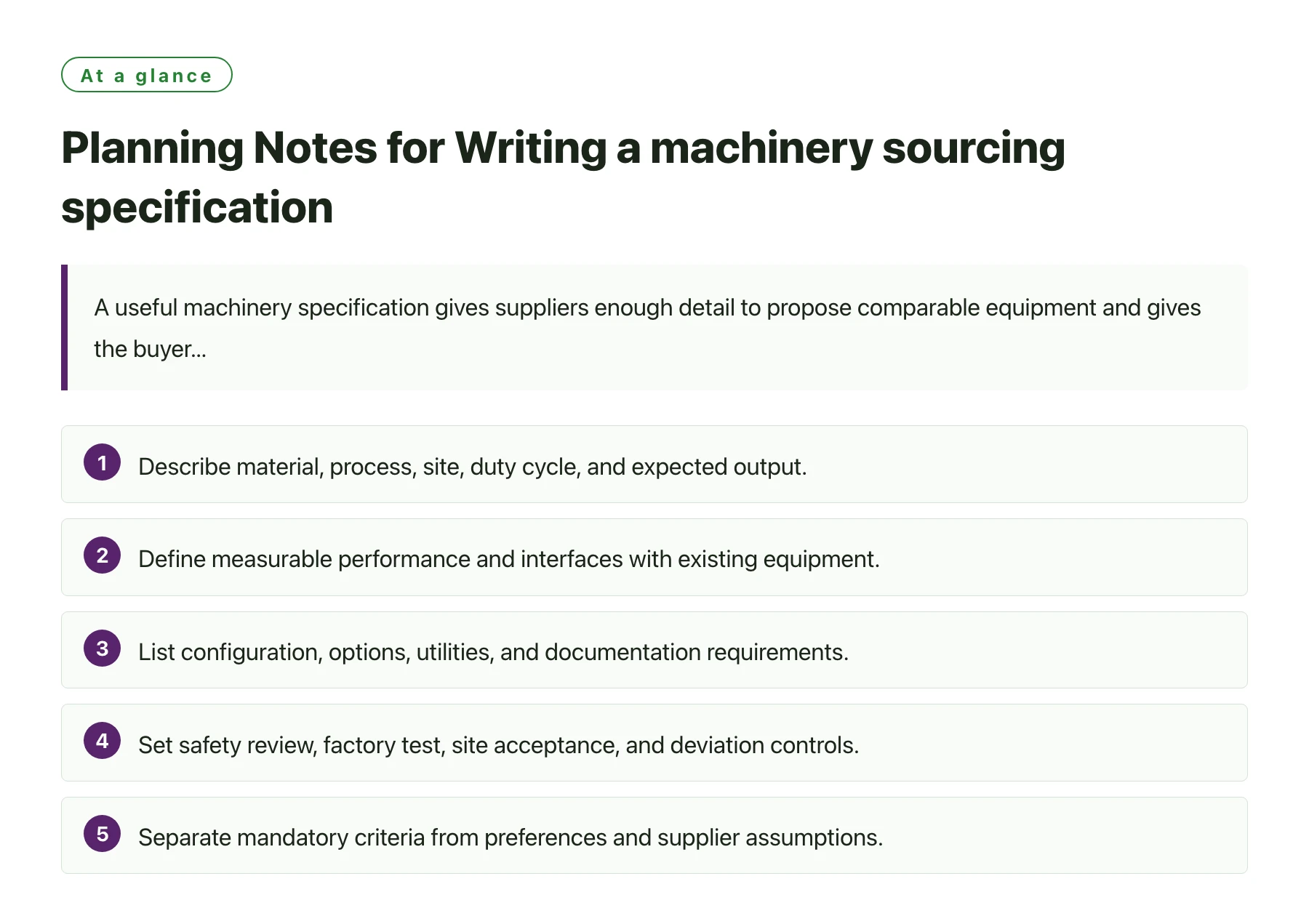
Key takeawaysDescribe material, process, site, duty cycle, and expected output. · Define measurable performance and interfaces with existing equipment. · List configuration, options, utilities, and documentation requirements. · Set safety review, factory test, site acceptance, and deviation controls. · Separate mandatory criteria from preferences and supplier assumptions.
The specification is both a supplier response template and the baseline for the eventual purchase order and acceptance plan.
1. Describe the task and operating environment
State what the machine must do, material inputs, output form, expected rate, shift pattern, duty cycle, product variation, and operator role. Include ambient conditions, dust, humidity, temperature, cleaning, and other factors that can affect performance.
Identify site constraints such as floor space, lifting access, foundations, power, air, water, exhaust, noise limits, and upstream or downstream equipment. Note which details are confirmed and which require a site survey.
2. Define functional and performance requirements
Specify throughput basis, cycle time, accuracy, repeatability, allowable defect rate, changeover, reject handling, recovery, and availability goals where relevant. Define how each value will be measured and under what conditions.
Separate guaranteed values from planning targets. Explain whether output is measured per cycle, hour, shift, or representative production run. If a requirement depends on the buyer’s material or tooling, describe the test input and responsibility.
3. List configuration and supply boundaries
Identify machine model or type, options, tooling, feeders, conveyors, guards, sensors, controls, software, accessories, spares, and training. State which components must be included and which may be quoted separately.
Create a boundary list for supplier, buyer, installer, and integrator responsibilities. Clarify wiring, cabling, network, mounting, foundations, lifting, anchoring, commissioning, and any auxiliary equipment. Include diagrams or layout references where needed.
4. Specify materials, interfaces, and utilities
Provide dimensions, tolerances, material grades, connectors, load limits, interface signals, communication protocols, and utility quality or capacity where known. List required upstream and downstream handshakes, data exchange, alarm behavior, and operator controls.
Use consistent units and reference datums. Identify prohibited materials or substances where applicable and any environmental or cleaning limitations. Ask suppliers to state assumptions for incomplete site information rather than silently selecting a design.
5. Include safety and risk documentation requirements
Ask suppliers to describe hazard identification, risk reduction measures, guarding, interlocks, emergency stops, labels, safe access, maintenance isolation, and operating instructions relevant to the proposed machine and application. Identify standards or market requirements that qualified project owners must confirm.
ISO 12100 provides general principles for machinery risk assessment and risk reduction. Reference it with appropriate scope and have qualified reviewers determine machine-specific and local obligations; the citation alone does not establish conformity. [1]
6. Set controls, software, and data expectations
Specify control architecture, operator interface language, recipe management, access levels, event logs, data export, backup, licensing, remote access, and supported protocols. Identify required alarms and production metrics.
Define software delivery, version identification, configuration backup, administrator credentials, update responsibilities, and change notification. If remote access is permitted, have the buyer’s IT and security owners approve its method and duration.
7. Define tests and acceptance evidence
State factory test prerequisites, test material, run duration, sample count, measurements, throughput and quality criteria, witness rights, report format, and defect disposition. Map each performance requirement to a test method that can demonstrate it.
Separate factory acceptance from site acceptance where utilities, installation, integration, or actual materials matter. Define retest, corrective action, shipment hold, and authorized release. Avoid criteria that cannot be measured or that suppliers interpret differently.
8. Require documentation and training
List manuals, drawings, parts list, electrical schematics, risk documents, test reports, certificates, maintenance instructions, troubleshooting, software backups, and spare part recommendations. Specify language, format, delivery date, and revision control.
Define training audience, duration, languages, hands-on tasks, attendance evidence, and whether training occurs at factory or site. Identify how documentation changes when configuration differs from the initial proposal.
9. State service, warranty, and lifecycle needs
Describe warranty start, coverage, response time, service location, travel, spare parts, software support, and excluded wear items. Ask for lead times and pricing basis for critical components.
Consider maintainability, access, routine service intervals, consumables, energy, and expected part availability. Specify support expectations without presenting supplier estimates as guaranteed lifespan. Include ownership and storage rules for custom tooling or buyer-funded design work.
10. Control supplier responses and revisions
Provide a response matrix with compliant, exception, alternative, evidence, and clarification fields. Require suppliers to reference the exact specification revision and attach deviations. Compare offers only after mandatory gaps are reviewed.
Buyers writing a industrial equipment sourcing support can use a controlled revision to align engineering, sourcing, safety, testing, and contract terms. Carry accepted requirements into the purchase order, and reassess if application, site, market, or operating conditions change.
Sources
Frequently asked questions
Should machinery requirements use measurable values?
Yes. Define units, conditions, method, tolerance, and evidence for each performance criterion.
What if the buyer does not know a site utility value yet?
Mark it as unconfirmed, set a survey owner and date, and ask suppliers to state assumptions and impacts.
Can one specification be sent to every machinery supplier?
Use a common baseline, then record product-specific annexes and deviations for each proposed configuration.
When should the specification be revised?
Update it after changes to application, site, interface, market requirements, or approved supplier design.