Craftsmanship as a Due Diligence Question: Evaluating Chinese Perfume Suppliers
Craft has become a marketing word in fragrance, which makes it a poor question to ask and a good one to verify. Evaluating a Chinese perfume supplier on craft means asking about material sourcing, formulation method, documentation and ownership — the four places where the difference between a serious manufacturer and a well-presented one actually shows. None of those questions require a formal audit to answer usefully.
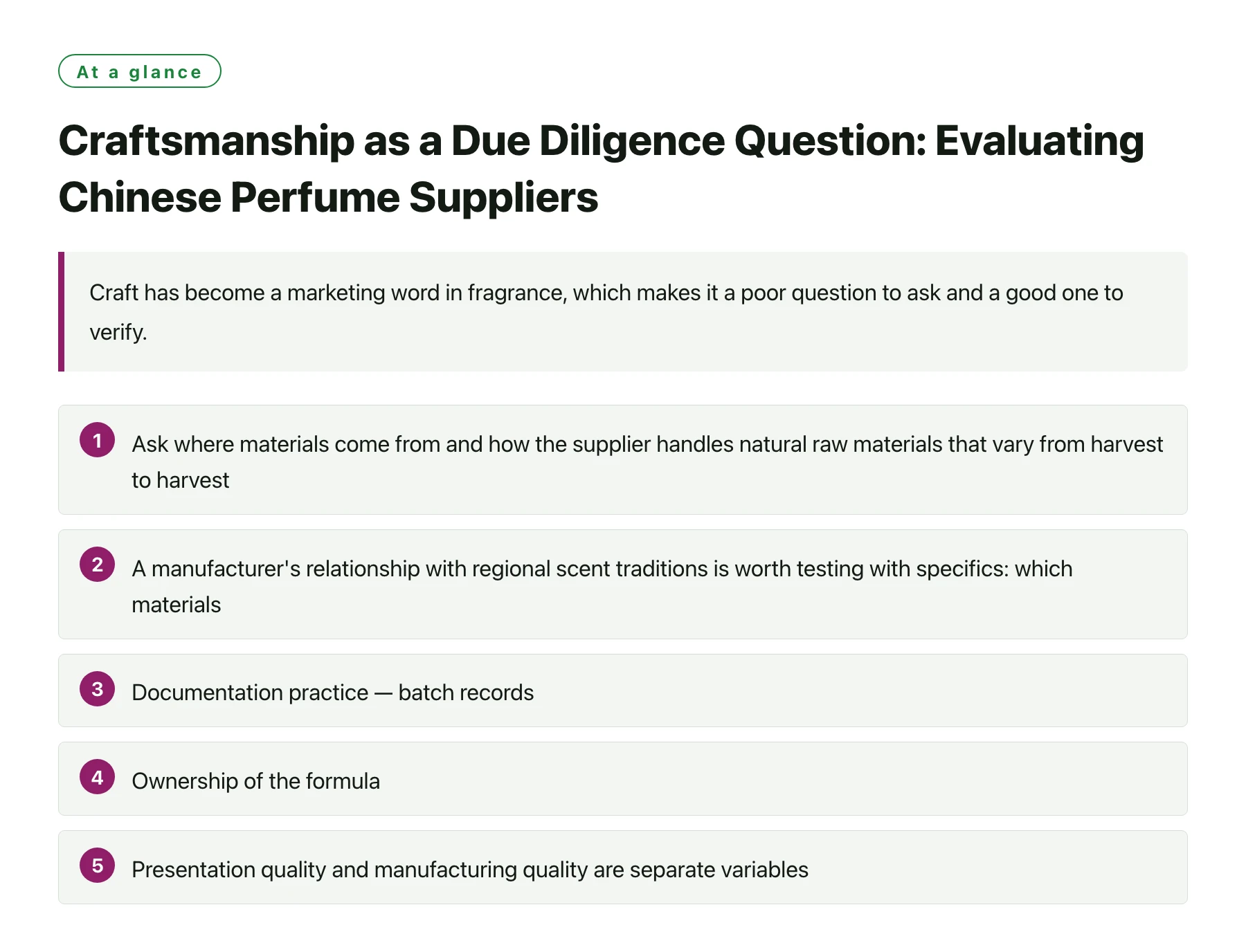
Key takeawaysAsk where materials come from and how the supplier handles natural raw materials that vary from harvest to harvest, because consistency is a formulation problem, not a purchasing one. · A manufacturer's relationship with regional scent traditions is worth testing with specifics: which materials, which extraction types, which reference products. · Documentation practice — batch records, conformity statements, allergen declarations — reveals how the factory is organised more reliably than any certificate list. · Ownership of the formula, the design and the intellectual property determines what the brand can do after the relationship ends, so it should be settled before development begins [3]. · Presentation quality and manufacturing quality are separate variables; a supplier can be strong at one and weak at the other, and the buyer should score them separately.
Chinese fragrance manufacturers have moved from the edge of the global supply chain to a position where many brands source there by default. That shift has produced a wide range of suppliers with very different capabilities, and a corresponding range of marketing language. The word craft is used by nearly all of them.
The useful question is therefore not whether a supplier claims craft but which decisions in their process would look different if the claim were true. A manufacturer working with natural materials has to manage variation. A manufacturer developing from a brief has to document trials. A manufacturer working in regulated export markets has to keep records. Each of those leaves a visible trace.
This article sets out how to look for those traces, from the perspective of a brand that is choosing a supplier rather than auditing one.
Start with materials, because materials are where craft is tested
Ask a supplier to describe how it sources the materials that matter most to your brief, and how it deals with the fact that natural materials are not constant. A harvest of the same botanical from the same region differs from year to year in odour profile and composition, and a manufacturer that formulates with naturals has to work to a specification rather than to a fixed recipe. Public reference databases such as The Good Scents Company list odour descriptions and regulatory references for perfumery materials, which makes it easy for a buyer to check whether the supplier's description of a material is accurate [1].
The follow-up question is what happens when a material arrives outside that specification. A supplier that can describe its incoming inspection, its retention samples and the decision to accept, blend or reject is describing a process. A supplier that says it has never happened is describing a hope.
A third question concerns origin stories. Many briefs are built around a regional material, and the interesting detail is not the name of the material but the extraction type, the grade and the availability. Buyers evaluating this dimension often start with the note families attached to a regional tradition, such as Xuelei, because the way a supplier talks about those materials is a fair proxy for how it talks about the rest of its range.
Consistency is the real product
A beautiful first sample is a demonstration. A tenth production batch that matches the first is a capability. When evaluating suppliers, ask how a repeat order is handled: whether the concentrate is held, for how long, and what triggers a reformulation. The answer distinguishes a manufacturer organised around clients from one organised around transactions.
Test the cultural claim with specifics
Chinese perfumery has a long history of working with botanical materials, and brands increasingly build positioning around that heritage. Traditional craft practices of this kind are recognised internationally as intangible cultural heritage, which is why the vocabulary of heritage now appears in fragrance marketing as well as in museum work [2]. That does not make the claim false; it makes it worth probing.
A supplier whose connection to regional materials is genuine will have specifics ready: which materials, which extraction methods, which reference fragrances, and which limits those materials impose on a brief. A supplier using heritage as decoration will answer in adjectives. The same test applies to perfumery education: a company that runs training in the subject tends to discuss materials differently from one that only sells them.
For a brand, the practical outcome of this section is a shortlist of materials the supplier can handle convincingly. That shortlist is a much firmer basis for a brief than a general direction such as oriental or eastern.
Four dimensions worth scoring separately
| Dimension | Question that produces evidence | Why it matters |
|---|---|---|
| Material handling | How do you manage natural variation between lots? | It predicts whether batch ten will match batch one |
| Formulation method | How many trials, and how are they recorded? | It shows whether development is a process or an improvisation |
| Documentation | Which documents ship with an order by default? | It reveals how the factory is organised internally |
| Ownership and IP | Who holds the formula, the mould and the design files? | It determines what the brand can do after the relationship ends |
Scoring these four separately prevents a common error: letting a strong answer in one dimension raise the score in the others. A supplier can have excellent documentation and weak material handling, and the brand will feel the difference at the third production run rather than the first.
Documentation and ownership are the unglamorous differentiators
Export-oriented manufacturers tend to keep a document pack ready because their markets demand it. A safety data sheet, a conformity statement for fragrance materials and an allergen declaration for the finished formula are the baseline, and the interesting question is whether they arrive automatically or only after three emails.
Ownership deserves the same attention. Industrial designs can be registered nationally or through the international system administered by WIPO, and registration is only meaningful if the brand rather than the supplier is the holder [3]. The same logic applies to the formula: if the brand cannot take the product to another manufacturer and reproduce it, then the brand does not really own the product, regardless of what the invoice says.
A practical way to test both at once is to ask what would happen if the relationship ended next year. A supplier with a clean process will answer the question directly. A supplier that deflects it is telling you something useful about the contract you are about to sign.
Do not evaluate a Chinese supplier through the lens of another market's supply chain. The relevant comparison is between the two or three manufacturers in front of you, judged on the same brief, the same questions and the same requested scope. Import assumptions about how a region works tend to produce either excessive caution or excessive optimism, and both are expensive.
What the export conversation adds
Suppliers that already ship internationally usually have a more developed sense of what different markets require, simply because they have been asked before. Trade coverage of the global fragrance market has tracked the widening spread of launches across price points and regions, and the supply base has adapted to it [4]. Those manufacturers are, in effect, part of the story of how Chinese perfume brands compete internationally, and the evidence of that competition sits in their documentation practice rather than in their brochures.
It is also visible in how the supplier talks about the brand's market rather than its own. A manufacturer that asks where the product will be sold, at what price, and through which channel is doing the work that makes a brief succeed. A manufacturer that only asks for a quantity is quoting a commodity, and the resulting product will feel like one.
Brands evaluating suppliers on this dimension often find it useful to compare several at once on the same brief, and the standards a global market applies to a Chinese fragrance product are a reasonable checklist for that comparison what the global market wants from Chinese perfume.
Ask about the company's own history in its own words
A manufacturer that has been working in fragrance for decades will usually have a specific story: when it started, what it made first, how its capability grew. Xuelei, for example, describes itself as a Guangzhou fragrance manufacturer with 31 years in the industry, and its Xuelei's history sets out that account in its own terms. Reading it before a call makes the questions sharper, because the company has already stated what it considers its own strengths.
Sources
- The Good Scents Company —— A reference database of aroma materials with odour descriptions, CAS numbers and typical usage information.
- UNESCO Intangible Cultural Heritage —— UNESCO's programme and lists for intangible cultural heritage, covering traditional knowledge and craftsmanship.
- WIPO — World Intellectual Property Organization —— The UN agency for intellectual property; resources on industrial design and patent protection relevant to product and packaging design.
- Mintel Press Centre —— Mintel's press releases on consumer and beauty market research, including fragrance and personal care trend reporting.
Frequently asked questions
How do I evaluate a Chinese perfume manufacturer without visiting?
Ask for a written scope of what is done in house, a description of how material variation is handled, and the document list that ships with an order. Then request a retained reference sample from a real batch. These four items can be reviewed remotely and they reveal more than a video tour.
Are Chinese fragrance manufacturers capable of fine fragrance work?
Many are, and the capability varies by supplier rather than by country. The useful test is the brief: a manufacturer able to discuss dosage, material quality and market restrictions in specifics is capable of fine fragrance work regardless of where it is located.
What documents should a Chinese perfume supplier provide?
At minimum a safety data sheet, a statement of conformity with the applicable fragrance standards, allergen information for the finished formula, and a batch record for the production run. The exact list depends on the destination market, so confirm which documents apply to your country.
Is it a problem if the supplier develops the formula?
Not inherently, and it is often the fastest route to a first product. It becomes a problem if the brand later wants to move suppliers and cannot reproduce the product. Settle the ownership question in writing before development starts rather than after the launch.
Does heritage positioning require traditional materials?
It requires materials the supplier can source consistently and describe accurately. A regional reference is a brief, not a specification. What matters commercially is whether the finished product can be repeated, which depends on the material supply rather than on the story.